Architecture
If Your App Platform Disappeared Tomorrow, What Would Stop Working?
Your application is a graph of dependencies, not a single box. Map which providers own each critical component to see where failure could spread.
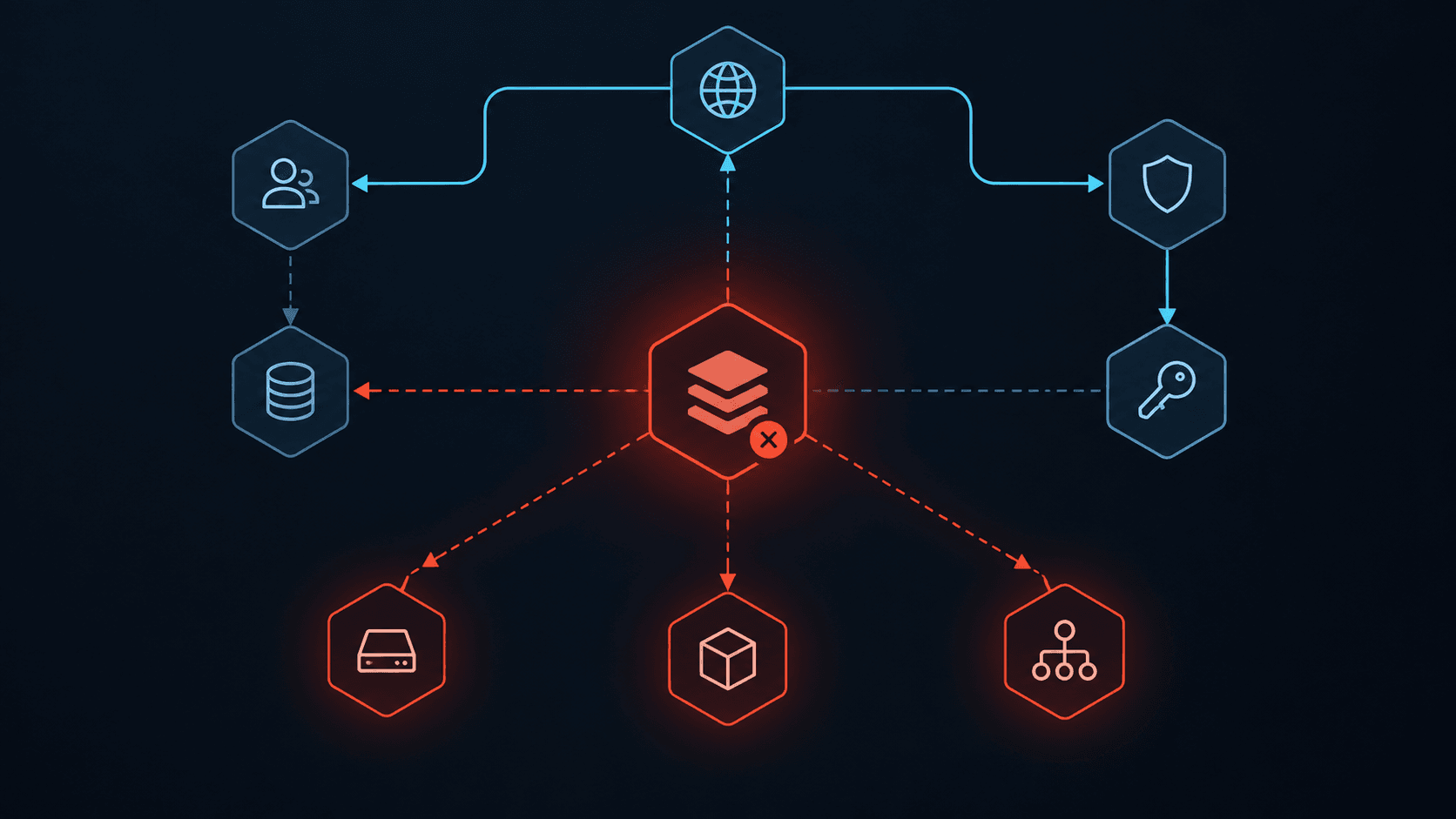

Your application is more than one box
Your application is not one box.
It only looks like one box when everything is working.
A typical AI-built product may actually depend on:
Putting the application in GitHub protects one component.
But what happens to everything else?
That is where dependency mapping becomes useful.
Architecture is not just what connects to what
A conventional architecture diagram might tell you:
App → API → Database
That is useful.
But for production readiness we also want to know:
- Who owns this component?
- Which provider hosts it?
- Is it stateful?
- Is it backed up?
- Can it be recreated?
- Does another critical component depend on the same provider?
- What happens if it disappears?
That turns a diagram into a diagnostic.
Imagine this architecture
At first glance this may be perfectly reasonable.
The interesting part is the concentration.
One provider may control:
- database;
- deployment;
- secrets;
- storage;
- logs;
- operational access.
Now imagine that provider becomes unavailable.
The blast radius is not simply:
“Deployment is down.”
It may also affect:
- database access;
- uploaded files;
- secret management;
- production debugging;
- recovery actions.
That is a different architectural risk.
What TenaxStack would look for
1. Recovery concentration
How many production-critical components depend on the same provider or control plane?
⚠️ Recovery concentration: multiple critical assets can only be inspected, changed or recovered through one provider.
2. Source protected, state unprotected
The code is independently stored in GitHub, but is the application state recoverable?
⚠️ Source protected, state unknown: source code is externalised, but no independent recovery path is known for production data.
3. Environment ambiguity
Can the system clearly distinguish development and production databases, secrets, domains and payment modes?
⚠️ Environment boundary unclear: development and production dependencies cannot be confidently separated.
4. Hidden provider configuration
Which settings exist only inside a vendor dashboard?
Examples:
- auth configuration;
- webhook endpoints;
- secret values;
- cron jobs;
- DNS;
- storage policies;
- deployment settings.
⚠️ Undocumented control-plane state: a critical configuration exists outside source control with no known reconstruction path.
The dependency test
For every important component, ask:
- Component: Source; Provider: GitHub; Business critical?: Yes; Recoverable?: Yes; Independent copy?: Yes
- Component: Database; Provider: Supabase / platform; Business critical?: Yes; Recoverable?: ?; Independent copy?: ?
- Component: Files; Provider: Storage provider; Business critical?: Yes; Recoverable?: ?; Independent copy?: ?
- Component: Auth; Provider: Auth provider; Business critical?: Yes; Recoverable?: ?; Independent copy?: N/A
- Component: Secrets; Provider: Platform; Business critical?: Yes; Recoverable?: ?; Independent copy?: ?
- Component: Runtime; Provider: Platform; Business critical?: Yes; Recoverable?: Maybe; Independent copy?: Source exists
- Component: Domain; Provider: Registrar / DNS; Business critical?: Yes; Recoverable?: Yes; Independent copy?: Independent
The question marks are useful.
Unknown architecture is itself a signal.
What not to conclude
This does not mean:
Move everything off your current platform.
A single provider can be exactly the right architecture for an early-stage company.
Adding more providers can create more operational complexity rather than less.
The real question is:
Is the concentration of dependency appropriate for the consequence of failure?
For a prototype: probably.
For an app with a few paying customers: possibly.
For software running a customer's daily operation: the answer may change.
The TenaxStack view
Traditional architecture tools help answer:
What does my system contain?
TenaxStack should increasingly help answer:
What does my business depend on?
and eventually:
If this component fails, what else fails with it?
That is where architecture becomes useful to founders rather than simply something engineers draw.
Sources
The research behind this article reviewed 10 public r/Replit and r/Lovable founder/builder threads from 11 Aug–10 Sep 2026 about real or near-production operations, deployment, migration, data access and platform reliability. 9 of 10 explicitly mentioned at least one of database/data access, deployment/environment state, migration/portability or production infrastructure control. This is a discussion-level convenience sample, not a market prevalence estimate.
Supporting platform sources:
- Replit import documentation — imports can bring code/schema while some existing data, secrets, domains and platform-specific state are not carried across.
- Replit version-control documentation — Git/GitHub is valuable for source ownership, which is why the distinction between source and full-system recovery matters.
What's next for you?
Draw your system as dependencies rather than just features. Mark which provider owns each critical component, which parts are stateful, and what would stop working if one provider disappeared. The goal is not to remove every dependency — it is to make the important ones visible.